
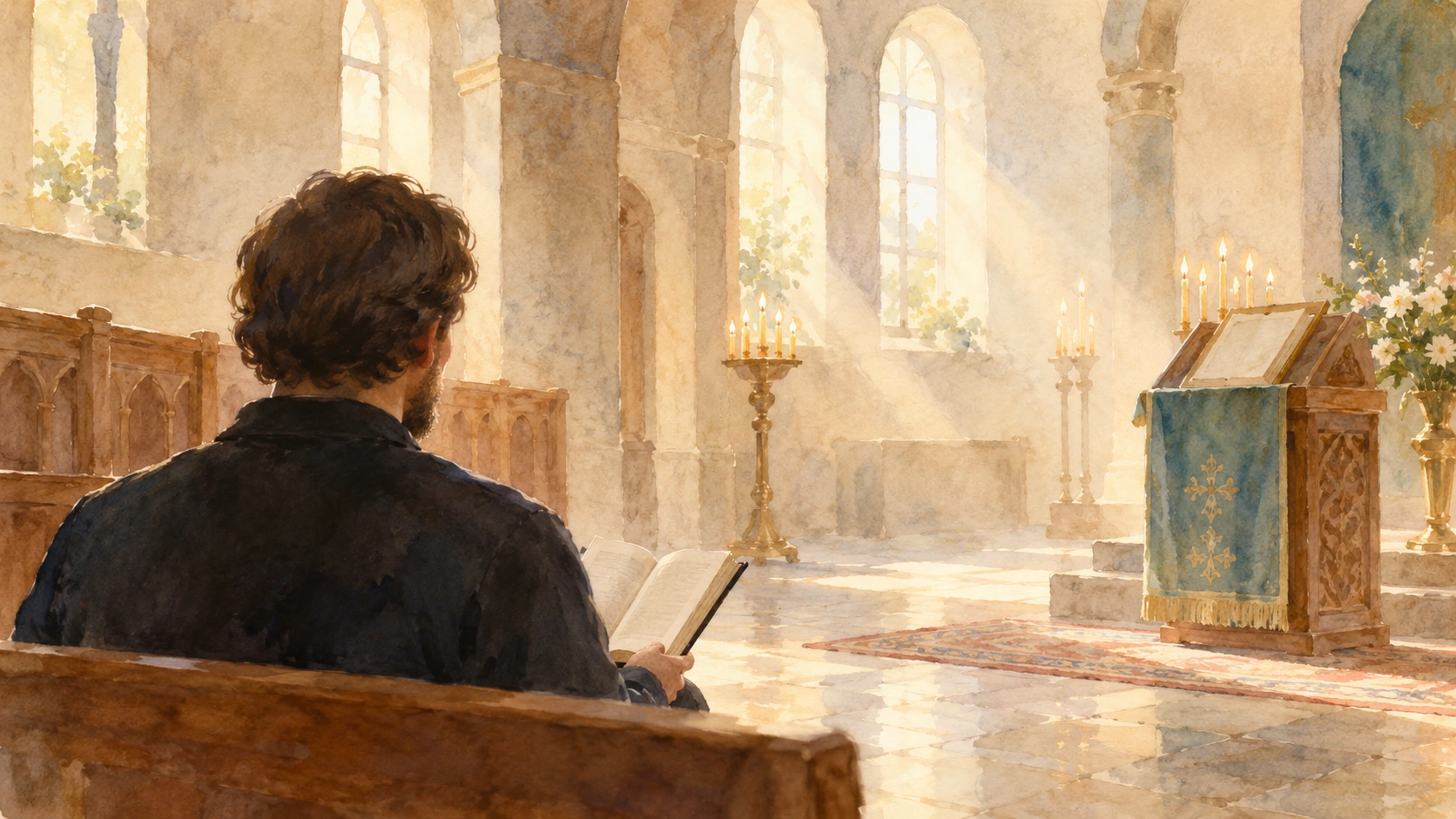
The singing ends, people respond, and the priest continues praying. You have recognized only a few words. You may love being in church and still find this exhausting. Difficulty with language does not mean a lack of faith, and you do not have to pretend indefinitely that you have no questions.
Orthodox parishes worship in different languages. Church Slavonic matters to many communities, but it is not the only possible language of Orthodox prayer. Greek, Arabic, or an unfamiliar translation can present a similar challenge when you visit a parish or move to another country.
Give one service one point of attention
Do not try to read a translation, watch every gesture, and identify every hymn at once. Choose an anchor: following the Gospel reading, for example, or understanding one litany, a sequence of prayer petitions with responses from the congregation.
The article on what happens at the Divine Liturgy can give you the overall shape beforehand. Knowing roughly where you are makes unfamiliar words feel less like an uninterrupted stream.
Find a text that matches
Ask the parish for a service book with a parallel translation or a link to the text it uses. A random file may follow a different translation or arrangement. It is easy to think you have lost your place when the pages simply do not correspond.
Read a short section in a language you understand before the service. Return to it during worship if that helps you listen. If following a screen continuously becomes tiring, put it aside and stay with one phrase whose meaning you know.
Check the day’s readings through the Church Calendar, then read the biblical passage in the Bible section. This is not a homework test. Prior acquaintance can help you hear what would otherwise pass too quickly.
Learn a familiar response in context
Short congregational responses gradually stop being unfamiliar sounds. Understand one phrase as a whole rather than memorizing a long vocabulary list. Notice which petitions it answers. Meaning then becomes connected with something actually happening.
You do not have to say everything aloud immediately. Recognition often comes before confident participation. Pray with the attention available to you and continue learning without pretending to be an expert.
Take one question away
“What was read before the Gospel?” or “Where can I find a translation of that prayer?” is easier to discuss than “I understand nothing.” Ask whether your parish offers introductory classes or conversations for newcomers.
If the difficulty remains substantial after several visits, tell the priest. A suitable book, an explanation, or a service in a more accessible language may be available. Seeking meaningful participation need not become an argument against someone else’s tradition.
One preparation and one question are enough for next Sunday. Understanding grows over time; it need not be set against reverence.