
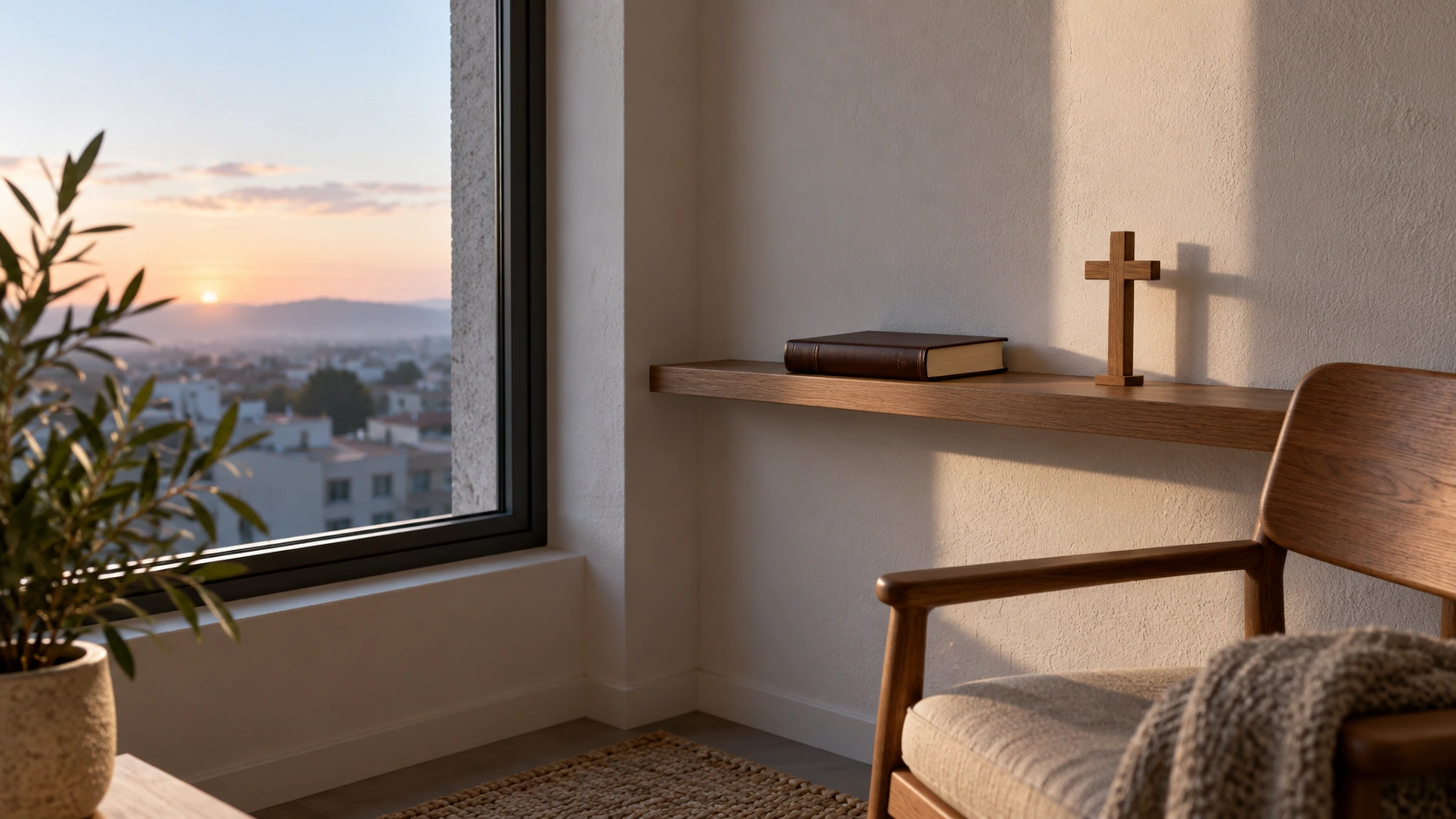
If you only manage to get to church occasionally, you can still pray at home today. You do not need to meet an attendance target, overcome every awkward feeling, or wait for a perfectly prayerful mood. Prayer is turning to God, not a reward for flawless church habits.
At the same time, prayer at home does not place someone outside church life or make the church unnecessary. It can sustain a relationship with God in ordinary days and help a person gradually seek living contact with a parish, without shame, comparison, or dramatic promises.
You can begin praying now
God is not confined to a church building. In the Gospel, Christ speaks of quiet prayer offered without display; this reminds us that turning to God does not require a special setting or another person’s approval (Gospel according to Matthew, 6:6).
Infrequent attendance can create the feeling that prayerful words are no longer appropriate. That feeling is understandable, but it does not have to decide for you. You might honestly say, “Lord, returning feels difficult; help me take the next step.” Your own simple words are not lesser because they feel awkward.
Prayer at home and church do not compete
Orthodox life includes personal prayer at home and shared prayer in a parish. At home, people bring gratitude, anxiety, and care for loved ones before God. In church, the community gathers for worship, and the sacraments belong to the life of the Church rather than private self-direction.
There is no need to choose between two extremes: attending everything or not praying at all. Home prayer can be genuine support during a limited season. At the same time, it does not replace the Eucharist, confession, or participation in the life of an actual parish.
- At home, you can give thanks, ask for help, and remember loved ones.
- You can pray for your parish, its priest, and the people you have met there.
- You can keep a brief prayer practice or speak to God in your own words.
- Home prayer need not become proof that you are entirely independent of the Church.
There are many reasons for infrequent attendance
Illness, caring for a child or relative, shift work, distance, transport, or limited accessibility may make attendance difficult. These realities should not be brushed aside with advice simply to try harder. People have different possibilities, and a considerate response matters more than an outward judgment.
Sometimes the obstacle is fear: it has been a long time, the order of service feels unfamiliar, or you worry about being noticed or questioned. You do not have to diagnose that feeling or condemn yourself for it. It is often enough to name the difficulty and choose one manageable action.
How to make a short pause for prayer at home
You do not need a special corner, icons, candles, a particular posture, or a timer to begin. If you have a prayer book, read one familiar prayer from the page. If you do not, a few attentive words and a minute of quiet are enough.
This is an editorial suggestion, not a required rule: choose a calm moment and do not try to fit everything into it. A brief address to God that you can return to tomorrow is usually kinder and more realistic than an exhausting promise that leaves you discouraged.
- Pause for a minute and name before God something for which you are grateful or something that feels heavy.
- Read one short prayer from a printed prayer book, or say a few words of your own.
- Remember a loved one by name and ask for peace and help for your parish.
You can reconnect with a parish in small steps
A helpful next step is to contact a particular parish instead of waiting for an ideal moment. You can ask about service times, step-free access, a quiet weekday visit, or a short conversation. Asking does not commit you to attending an entire service immediately.
If illness or care responsibilities keep you at home, you can ask the parish about pastoral visiting or other support. Parishes and clergy have different capacities, so no response can be guaranteed in advance. Yet a calm first contact often makes the situation clearer.

An online service does not replace the sacraments
An online broadcast can sometimes help you hear a service, pray in a familiar rhythm, or keep a connection when attending is impossible. It can be received as support, not as another reason to blame yourself for being absent.
Communion cannot be received through a screen. Nor should someone decide alone that infrequent attendance or prayer at home automatically means they are prepared for Communion. It is better to discuss your real circumstances and preparation with a priest at a particular parish.
- A broadcast can accompany prayer when getting to church is temporarily impossible.
- It does not remove the place of personal participation in the sacraments when that is possible.
- Within a household, no one needs to impose a shared ritual or demand the same form of prayer from others.
One next step matters more than a large promise
Try joining two simple actions: pray briefly at home today, then write or call one parish soon. You do not need to promise a regularity that may be hard to sustain. It is enough to see your present circumstances honestly and take an available step toward connection.