
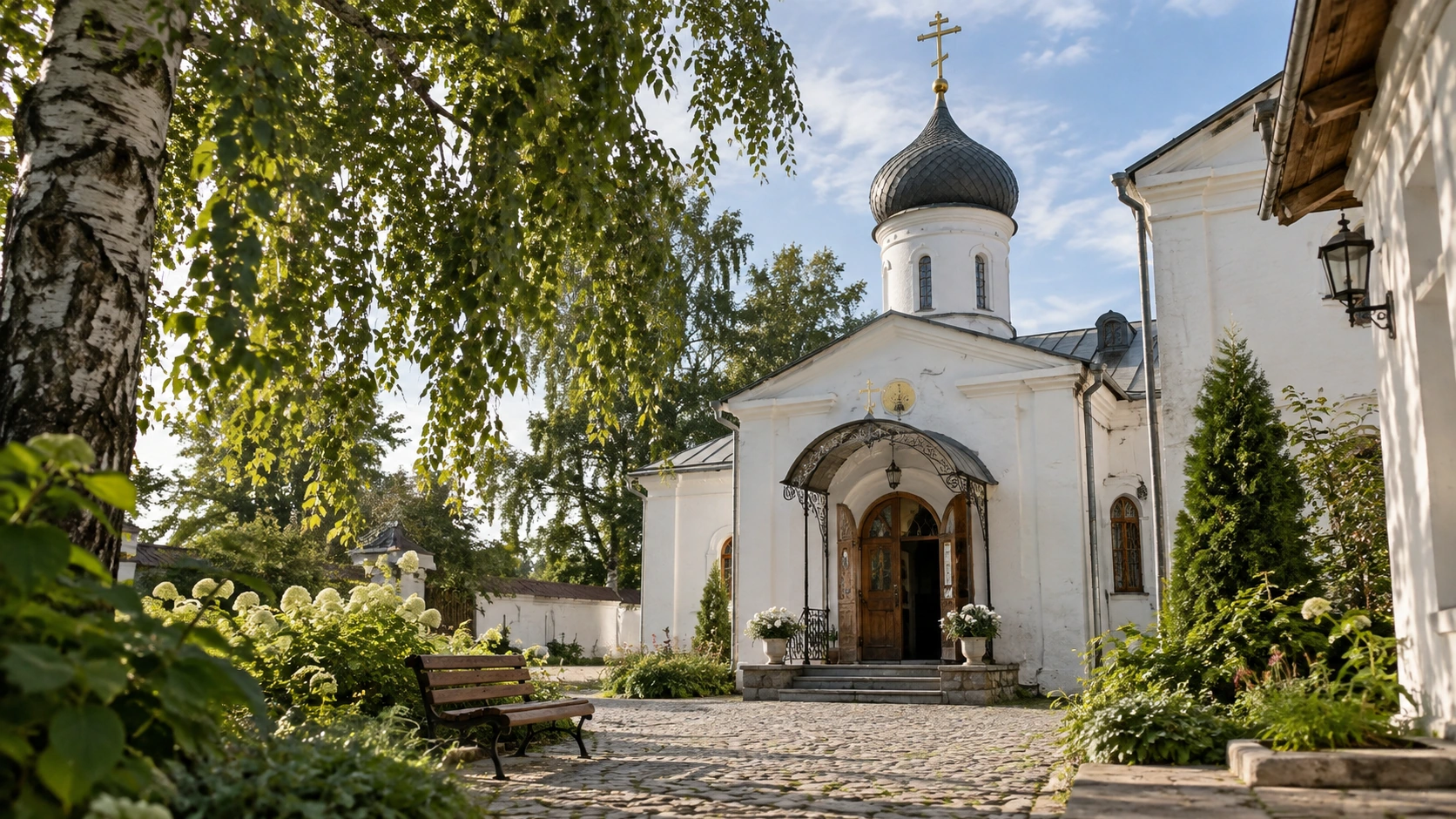
The Divine Liturgy is the central shared worship of the Orthodox Church. Christians do not merely watch clergy perform a ceremony: the whole community prays, responds, gives thanks, and offers its life to God. The word “liturgy” originally means a common work. Its purpose is therefore greater than beautiful singing, ancient vestments, or a familiar sequence of actions. The Church gathers around the risen Christ, confessing the Father, the Son, and the Holy Spirit.
Not a performance, but a meeting and thanksgiving
The heart of the Liturgy is called the Eucharist, a word meaning thanksgiving. The Church thanks God for creation, mercy, the incarnation of the Son of God, Christ’s Cross and Resurrection, and then prays for peace, for people, and for the needs of the world. There is no division between “performers” and “audience.” Some sing in the choir, some read, and some pray silently, yet all are invited to take part with attention and freedom.
In the Gospel account of the Last Supper, Christ gives His disciples bread and the cup as His Body and Blood and tells them to do this in remembrance of Him. This is a retelling of the Gospel narrative, not a liturgical quotation: Gospel according to Gospel of Luke / Chapter 22 / Verses 19–20. Orthodox Christians confess that in the Eucharist they receive Christ’s true Body and Blood, not merely a symbol that recalls Him. This Mystery is a holy reality of God’s grace, not a magical act or a private experience on demand.
Before the service: bread and wine are prepared
Before the main public part of the service, the priest prepares bread and wine for the Eucharist. This preparation is often called the proskomedia, meaning the preparation of the offering. Particles are taken from the bread in remembrance of Christ, the Mother of God, the saints, and the living and departed for whom prayer is offered. Even when visitors do not see it, this act shows that the Church comes to the chalice not as a circle of flawless people, but as a people in need of God’s mercy.
The opening: peace, petitions, and psalms
The Liturgy opens with a blessing of the Holy Trinity and with litanies, brief petitions to which the people usually respond by asking God for mercy. They include prayer for peace, the Church, civil authorities, travelers, the sick, the suffering, and the salvation of all. Psalms, antiphons, and hymns lead the gathering into biblical prayer. A newcomer does not need to understand every movement or phrase at once; it is enough to listen calmly and join the repeated petitions with one’s own prayer.
For a first visit, three simple guides are enough:
- Arrive a few minutes early, so that you do not enter in a rush.
- Use a service text or translation as a help, not as a test you must pass.
- If fatigue or health makes standing difficult, sit where it is permitted and practical; caring for health is not disrespect for prayer.
The Word of God: Epistle, Gospel, and sermon
The Liturgy includes readings from Holy Scripture: usually the Epistle, a reading from the New Testament outside the Gospels, followed by the Gospel. Before the Gospel, the community gathers its attention especially carefully because it hears the witness to Christ’s words and deeds. A sermon may follow the reading or come elsewhere in the service, depending on local practice. Its purpose is not entertainment, but help in hearing the Gospel within life today.
The Great Entrance: the gifts are not yet consecrated
During the Great Entrance, the bread and wine are carried solemnly to the altar table. The moment can be moving, but it should not be confused with the consecration itself: at this point the gifts have not yet become the Eucharistic Gifts. The procession expresses the offering of all life to God and recalls Christ’s willing path toward His suffering. The faithful pray that the Lord will remember all those especially in need of His help.
The Creed and the Eucharistic prayer
After the gifts have been prepared, the community recites the Creed: faith in one God the Father, in Jesus Christ as true God and true man, in His death and bodily Resurrection, and in the Holy Spirit. The central Eucharistic prayer follows: thanksgiving to the Father, remembrance of Christ’s saving work, and invocation of the Holy Spirit upon those gathered and upon the offered bread and wine. The Church confesses their sanctification as Christ’s Body and Blood; this is God’s work, not a human skill. After the Eucharistic prayer and further petitions, before Holy Communion, the community prays the Lord’s Prayer.
Communion and the end of the service
Holy Communion unites a believer with Christ and His Church. It presumes faith, baptism, chrismation, and preparation in keeping with the guidance of the priest in one’s community. The ordinary Orthodox practice is to commune baptized and chrismated Orthodox Christians who have prepared as their parish priest blesses. Practices of preparation, including fasting and confession, may vary with circumstances and local custom. They should not be guessed at or imposed on oneself without conversation.
Guests, including non-Orthodox visitors, are normally welcome to attend respectfully, pray, and observe, but should not approach the chalice out of curiosity. Thanksgiving prayers, a blessing, and the dismissal follow Communion; the dismissal sends the people out in peace. Some parishes offer bread after the service. It is not the Eucharist and does not replace Communion. Ask an usher or priest what it means in that parish and what the local custom is.
How to come for the first time without anxiety
In Orthodox churches, people usually stand, make the sign of the cross, light candles, and venerate icons, but none of this is a knowledge test. You may stand quietly at the side, follow the congregation, and avoid trying to imitate everything at once. Dress modestly without distracting others; particular parish expectations may differ. Do not take photographs or hold conversations during the service without permission. If you wish to speak with a priest, it is often best to wait until the service has ended and he is available.
You do not need to experience anything unusual on the first day. You may hear only one line, notice a petition for peace, or sense how shared prayer carries people of different ages and circumstances. Returning for several services gradually makes the order clearer. If questions concern personal preparation, painful experience, or obstacles to Communion, a careful conversation with a priest in your parish is more dependable than general advice.