
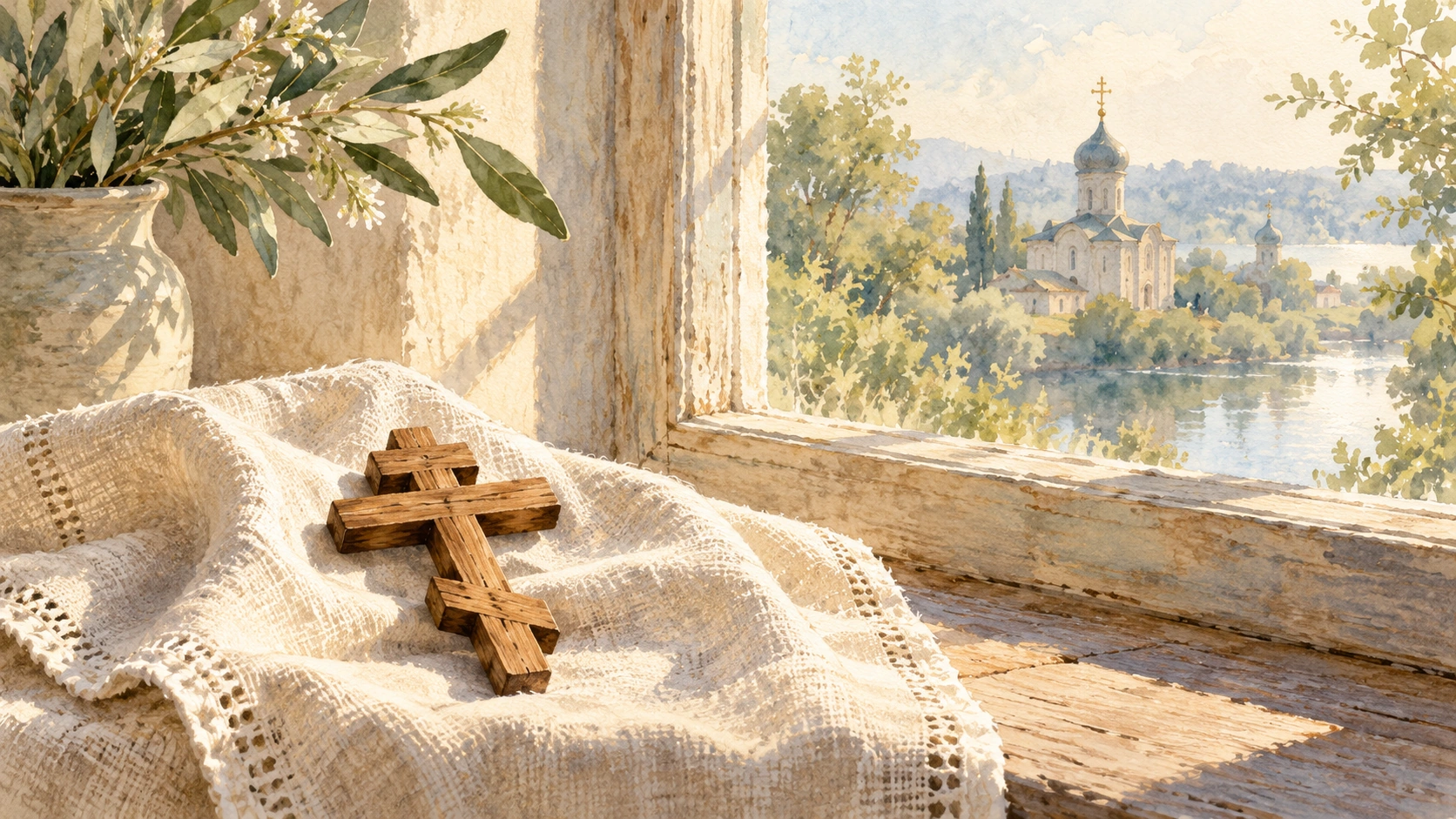
At the church door, people cross themselves. Someone does it again before an icon, someone during a prayer. Trying to copy every movement can leave a first-time visitor more confused than before. Start with one gesture and its meaning. Familiarity can come later.
A prayer made with the body
The sign of the cross expresses faith in Christ and his Cross. It is a way of turning towards God with more than words, offering him our thoughts and actions. It is not a protective mechanism that works independently of faith or guarantees a good outcome.
In the usual Orthodox practice, the thumb and first two fingers are brought together as a sign of the Holy Trinity. The remaining two fingers rest against the palm and are associated with Christ being truly God and truly human. These meanings help explain the gesture; they do not make it a test of coordination.
Making the movement
Using your right hand, bring the three fingers together. Touch your forehead, then your chest, then your right shoulder and your left shoulder. Move deliberately rather than quickly. If you make a bow afterwards, finish the sign of the cross before bowing instead of combining everything into one hurried movement.
You can try this a few times at home. There is no need to aim for mathematical precision or rehearse until you become anxious. If illness or limited movement makes the gesture difficult, explain that to your priest. Physical ability does not determine the worth of a prayer.
What to say
You might say, “In the name of the Father, and of the Son, and of the Holy Spirit. Amen,” or make the sign while offering another short prayer. You do not have to fit a separate word to every point your hand touches. Let the movement support your attention to God rather than distract you from it.
When people cross themselves
Orthodox Christians commonly do so at the beginning and end of prayer, when entering church, and at certain moments in worship. You need not memorize every occasion during your first service. Watch quietly, join in where you understand, and ask about anything that puzzles you afterwards.
There are variations among Orthodox traditions. Someone whose gestures differ from what you have learned is not necessarily doing something wrong. Learning your own parish’s practice is more useful than correcting strangers.
If you get it wrong
If you touch the shoulders in the wrong order, take a breath and continue. A mistaken movement does not mean God has rejected you or that your prayer is ruined. Next time, slow down a little. Repeatedly starting over out of fear is unlikely to help you pray attentively.
If the difficult part is fear rather than remembering the movement, you can Ask Father Peter. The gesture is there to support prayer, not to become another thing to be frightened of.