
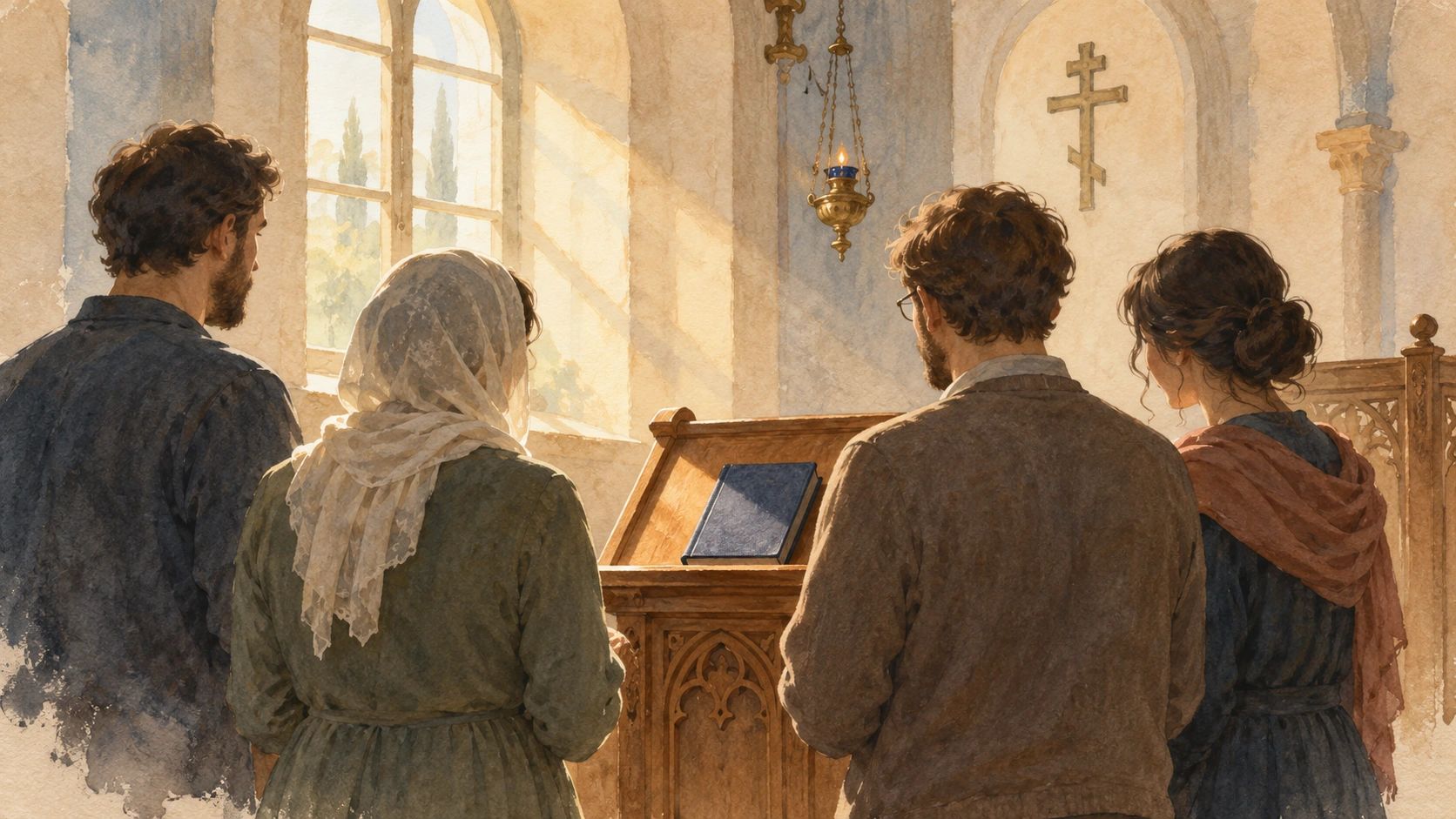
After a first church visit, the clearest memory may be a melody rather than the sermon. You do not yet know the prayers by name, but you remember the choir answering the priest and a moment when you stopped rushing. Music can open a door into Christian life. The next step is to hear what the beautiful sound is saying.
Christian musical traditions are varied. This introduction focuses on Orthodox worship and the questions that often arise when someone first encounters its singing.
Why do Christians sing in worship?
Singing belongs with prayer and the sharing of faith. In Colossians, chapter 3, verse 16, Saint Paul connects thanksgiving to God, teaching one another and singing psalms and spiritual songs. The passage is not a prescription for a particular musical style. It points towards the purpose of the voice.
Melody can help us attend to and remember words. The central action, though, is addressing God in thanksgiving, repentance, praise or a request for mercy. Asking whether the performance was beautiful cannot fully explain what happened in worship.
What is being sung?
Orthodox services include psalms, prayerful responses and hymns connected with Christ’s resurrection, a feast or the commemoration of a saint. Some words recur regularly; others unfold the subject of that particular day.
A helpful first question is: who is being addressed, and what is the text saying? A request for mercy is prayer. A reference to an event in the Gospel invites further reading. The church calendar can help explain why a particular theme appears today.
Why does it sound different from church to church?
You may hear a single chanter, a small group or a choir singing in harmony. Byzantine chant and the choral sound familiar in many churches of the Russian tradition can feel quite different. An unfamiliar melody does not automatically mean an unfamiliar faith.
Unaccompanied vocal singing is characteristic of Orthodox tradition. But the experience of one parish should not become a claim about all Christian music, which encompasses many forms. Nor can prayerfulness be measured simply by how slow, loud or technically complex a piece sounds.
Must I join in?
You do not need musical training to attend. Listen attentively, follow a clear text and join shared responses where that is the parish’s practice. There is no need to sing over the choir to compensate for not knowing the service.
If you want to participate more, ask the choir director which responses you could learn or whether beginners can attend a rehearsal. Not reading music does not make a person less capable of prayer. A small, well-understood response is a worthwhile beginning.
Worship and a concert are different settings
At a concert, attention naturally turns towards the performance. In a service, singing belongs to a shared act of worship alongside readings, petitions and other actions. The choir gives voice to that prayer rather than presenting an isolated musical item between the important parts.
You may enjoy a recording aesthetically, while learning its place in the service adds another dimension. Our introduction to the Divine Liturgy provides context if you are unsure what is happening. A familiar hymn then becomes part of a recognisable whole.
Listening thoughtfully at home
Choose one short hymn with a clear title and an available text. Read the words, then listen without scrolling through news at the same time. Afterwards, ask what thought the hymn expresses. This is a suggestion for attentive listening, not a compulsory prayer rule.
Avoid treating a recording as a special healing frequency or promising yourself that one melody will remove anxiety and solve a difficulty. Music may support attention, but it does not replace help from people or necessary practical action. Hearing a recorded service is also distinct from personally participating in the Church’s sacraments.
What about ordinary music?
A genre label alone does not tell you what a song is doing in your life. Consider its words and the attention you give it. What are you endorsing when you repeat the lyrics? Does constant listening make it harder to notice the person beside you?
These questions can be more useful than searching for a universal list of approved artists. Meanwhile, exploring church singing can begin with one manageable action: find the words of a prayer you have heard and learn what they mean. If a passage puzzles you, you can Ask Father Peter.