
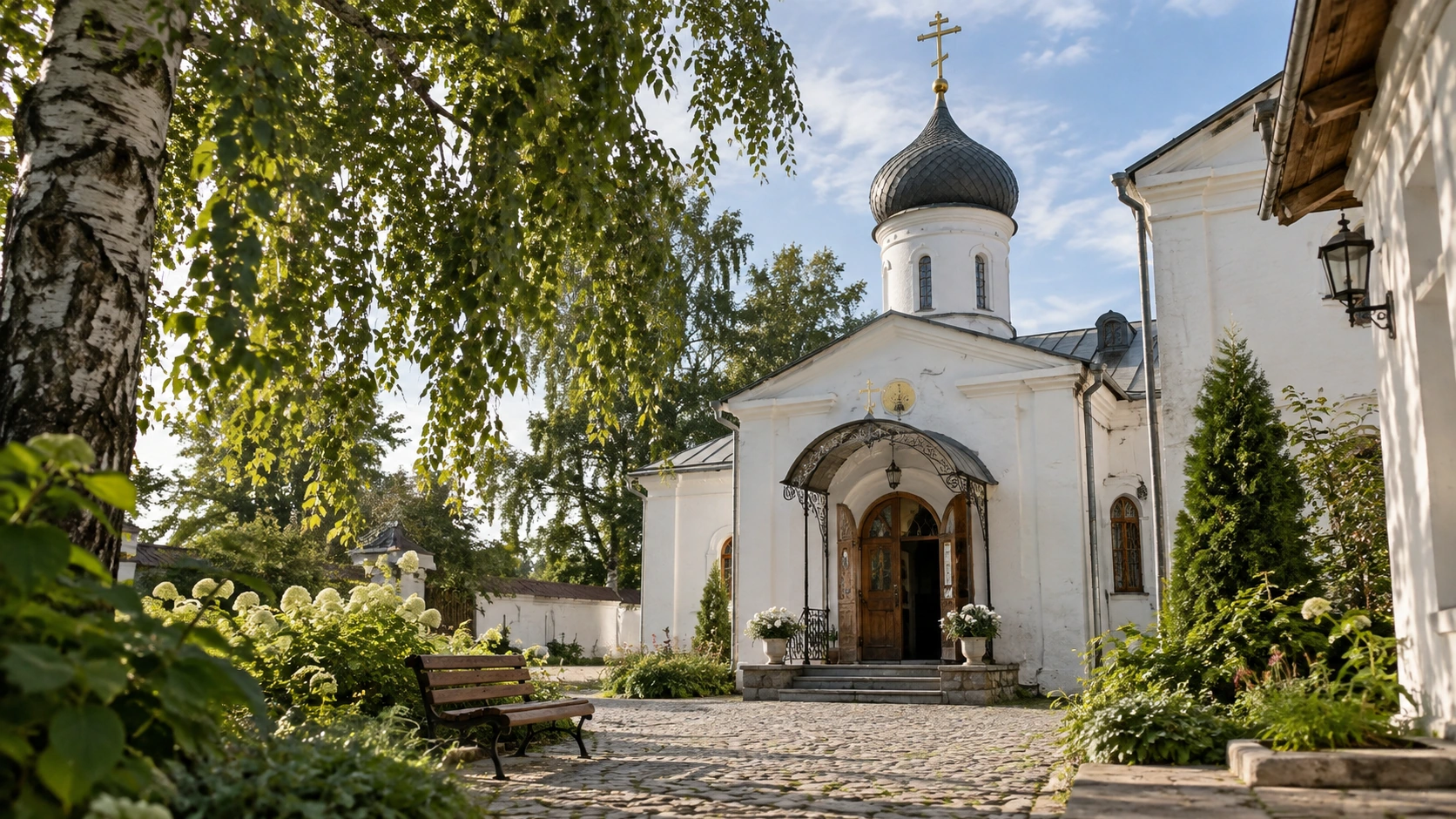
Prayer at home and worship together
Personal prayer matters, but Christian life is not made up only of a person's relationship with their own thoughts. In worship, we turn to God together with others. This can be difficult: someone may distract us, something may be unclear, and familiar comfort disappears. Yet here it gradually becomes apparent that faith does not belong only to my mood, and that nearby are people with their own concerns, pain, and hope, whom prayer also touches.
There is no need to set home and church against each other. You can read the Gospel at home and hear it in the community, pray personally and take part in worship. One does not have to cancel out the other. At the same time, attending church in itself does not replace attentiveness to those close to us and to our own lives. If someone remains harsh and indifferent after a service, the important thing is not to conclude that church is useless, but to ask honestly how what they have heard is connected with their actions.
More than a beautiful space
Architecture, icons, and singing can help us pay attention. But a church is not simply a place for a pleasant feeling or a good photograph. In Orthodox life, it is connected with prayer, the Sacraments, and the community. If everything is reduced to an impression, a difficult or uncomfortable visit will seem like a complete failure. Yet the meaning of worship does not depend only on how much you liked the sound, the light, or people's behavior on that particular day.
This does not mean difficulties should be ignored. If you do not understand what is happening, you can ask. If you feel confused, it can help to choose a short first visit and gradually become familiar with the service. You do not have to know at once how to follow every part of the worship. Sometimes the first step is simply to come and remain quietly, without pretending to be an experienced person. The next is to learn what you heard and what place it has in the common prayer.
The Sacraments cannot be replaced by a shared mood
In the Orthodox tradition, church life includes Confession and Communion. These are not decorative additions to personal spirituality, nor are they ways to obtain guaranteed relief. Preparation and questions about participation need to be discussed with a priest in light of your situation. An article cannot prescribe a universal rule for a person the author does not know. Still less should such rules be taken from a random short video, where a confident tone replaces careful explanation.
If you have not taken part in church life for a long time, or have never done so, say so directly. You can ask where to begin, when it would be convenient to talk, and what is required in a particular parish. There is no need to guess or painfully pretend to know. A calm conversation helps turn a vague fear of behaving wrongly into a few understandable steps. Questions about personal circumstances are better discussed directly than resolved by comparing yourself with someone else's story.
When people make you uncomfortable
Someone may avoid church after a sharp remark or an unpleasant conversation. Such an experience should not be dismissed. Rudeness hurts, especially where acceptance was expected. We can acknowledge this and not excuse everything believers do simply because it took place in a church building. But it is also helpful to distinguish a particular episode from the whole of faith. One person, even a confident and prominent one, has no right to represent all Christianity.
Sometimes it is sensible to speak with a priest, choose another time, or choose another parish. This is not necessarily running away from a difficulty; it may be a search for a place where it will be possible to begin a relationship more peacefully. At the same time, a community will not consist of faultless people. Gradually, we have to learn to be alongside different kinds of people, without losing our boundaries and without turning another person's weakness into a reason for our own harshness. This work belongs to the everyday side of church life.
How to make a first visit manageable
Check the schedule and address in advance, so as not to add unnecessary rushing. If you have practical questions, clarify them on site or through the parish's official contact. Choose a time you can genuinely devote to the visit. Do not promise yourself that you will immediately endure an unfamiliar, lengthy service without becoming tired. What matters is not setting a record, but becoming acquainted with what is happening and keeping the possibility of returning. If necessary, step out calmly and continue getting acquainted another day.
During the service, you can pay attention to one text or one part of a prayer. Do not try to understand everything immediately. After the visit, write down what interested you and what remained unclear. Then the next conversation will have a specific subject. Do not judge the visit only by how you felt: sometimes it passes calmly and without vivid experiences, yet leaves an important question. That question can become the beginning of a deeper acquaintance if you do not rush to close it with a ready-made phrase.
What happens after you leave
The meaning of a visit does not remain behind the door. You can ask yourself how what you heard affects the day ahead. Is there someone with whom you want to be reconciled? Do you need to keep a promise, help someone close to you, or acknowledge your own mistake? There is no need to turn this into a required list of achievements. But it is helpful to preserve a small connection between worship together and your own life. Otherwise, church gradually becomes a separate event that has no bearing on work, home, or relationships.
If attending is impossible right now because of illness, caring for someone close to you, or other circumstances, do not make it a verdict on your faith. Discuss available forms of support with a priest, and maintain such prayer as you are able. Church life should not be measured only by the outward uniformity of people in different circumstances. But when the opportunity arises, taking part in the community can help us see that the way to God does not have to be traveled entirely alone, amid our own questions and expectations.