
Begin with what you have
Choose a few minutes when no one is rushing you. You do not have to wait for a special mood or perfect silence. You can sit down, put your phone away, and say in your own words why you are turning to God. For example, you may want to ask for help with a difficult matter, give thanks for someone close to you, or make sense of your confusion. Such words are your prayer, not a quotation from a prayer book. Their simplicity does not make your address any less serious.
If you are not sure that you believe, you can say that too. You do not need to convince yourself of everything first and only then earn the right to turn to God. It is more honest to speak of doubt than to pretend to be certain. The beginning of spiritual life is often uneven: today there is attentiveness, tomorrow there is not. Do not draw a final conclusion about yourself from one successful or unsuccessful day. You are learning a new way of being present before God, and that takes time.
Brief does not mean superficial
A long prayer can sometimes seem more genuine than a short one. But the number of words does not always correspond to attentiveness. A few thoughtful sentences may prove more helpful than a long text read only for the sake of finishing it. Begin with a small amount that you can repeat even on an ordinary day. If you immediately set yourself the task of half an hour in the morning and evening, fatigue may turn it into a burdensome duty that makes you not want to begin anything at all.
It is helpful to choose a clear foundation: gratitude, a request, and remembrance of the people for whom you want to pray. You do not have to go through every point each time. You can linger over one. For example, today you remember someone with whom you quarrelled and ask for help not to answer them harshly. Prayer becomes connected with life when, behind the words, you see a particular name, a particular action, and a particular responsibility—not only an abstract feeling.
Your own words and a prayer book
In the Orthodox tradition, there are prayers used by many generations of believers. A prayer book helps us not to remain enclosed in our own wishes and experiences alone. But you can get to know it gradually. Choose one short text, read it calmly, and look into unfamiliar words. If the meaning escapes you, ask a priest or find a reliable explanation. There is no need to pretend that church language is clear the first time. Careful study is better than mechanical reading.
There is no need to set your own words against established prayers. One day a traditional text may help you; another day, a simple address about what has happened may help. You can read a prayer and then name those you are concerned about. You can begin with your own words and open a prayer book later. What matters is not turning this freedom into an endless search for the most effective formula. Prayer is not a way of finding a password after which God is obliged to grant a request.
«But thou, when thou prayest, enter into thy chamber, and having shut thy door, pray to thy Father who is in secret; and thy Father, who seeth in secret, shall reward thee openly.»
Gospel of Matthew / Chapter 6 / Verse 6Synodal Bible — translated from Russian
A place helps, but does not replace attentiveness
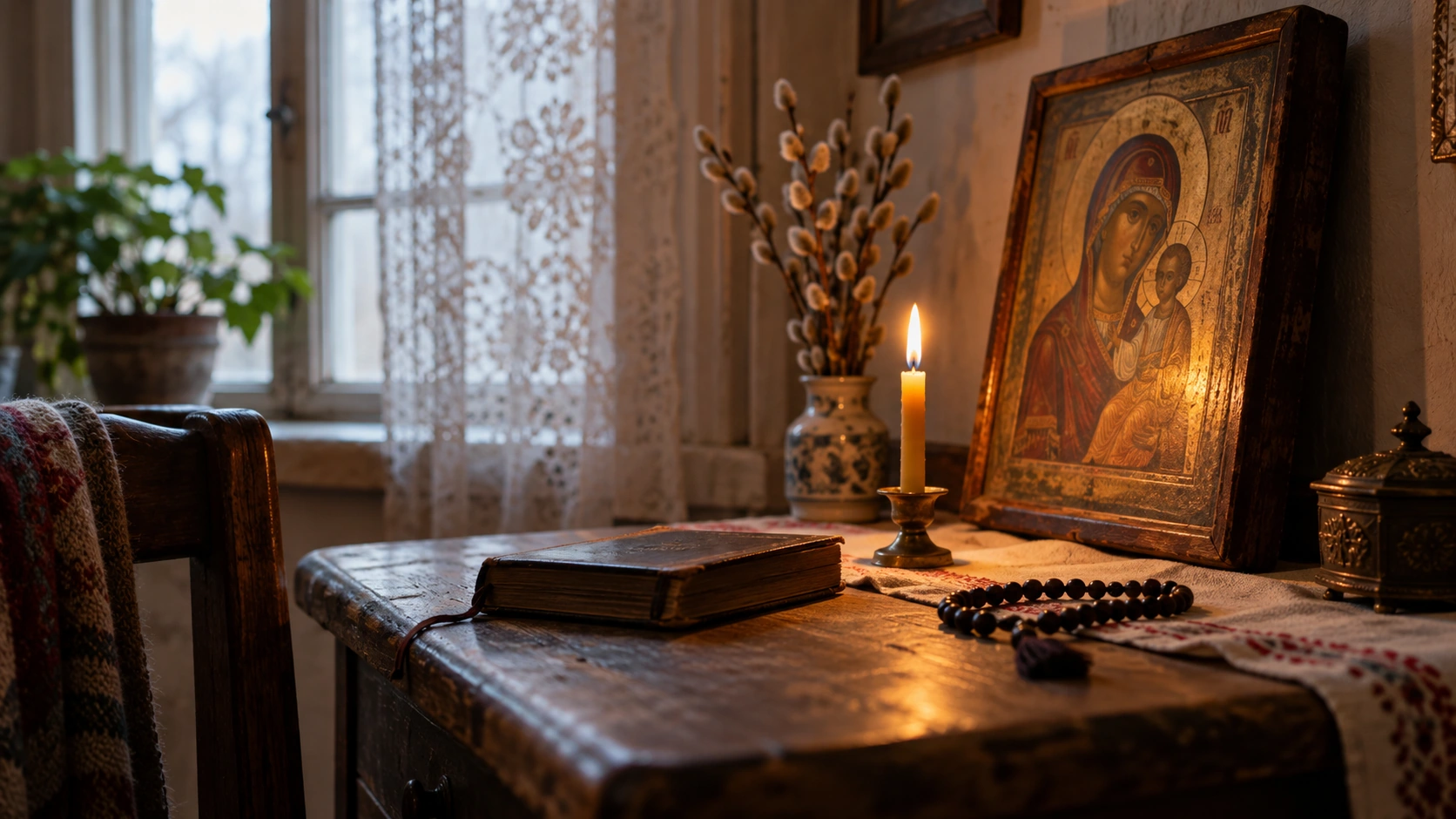
A small regular place at home can make it easier to begin. Nothing expensive is needed there. It is enough to have a space where you can pause and not be distracted by a screen. An icon in an Orthodox home serves as a reminder of the One to whom prayer is addressed. It is not an object that automatically changes one’s mood or protects from every trouble. The same is true of a candle: it can help you focus, but it does not make words valid simply because it is burning.
If you currently live in a cramped space or share a room with others, there is no need to put off prayer until you have a separate corner. You can find a short time by a window, on a walk, or before sleep. Do not try to display your practice to those around you. But do not regard inconvenient living conditions as proof that spiritual life is closed to you. Attentiveness to God is possible in ordinary surroundings, amid work, household noise, and cares.
What to do about distraction
A thought about buying groceries, unfinished work, or yesterday’s argument may arise right in the middle of prayer. This is no reason to scold yourself and begin again ten times. Notice that you have been distracted, and return to the words. If the worry does not let go, you can include it in your address: ask for help in dealing with the matter and not taking your anxiety out on those close to you. Sometimes it is helpful to write down an urgent task beforehand so that you do not have to keep it in your mind.
Do not wait for the complete absence of stray thoughts as a condition for real prayer. Such a standard makes beginning unattainable. You can learn attentiveness through small returns, as you learn to listen to someone when the day has been difficult. What matters is not how many times you notice your distraction, but that you keep returning without despair. Calm regularity often proves more reliable than a tense attempt to achieve a flawless state once and then never lose it.
A small rhythm for the first week
Try linking a short prayer to a steady moment in the day: after washing up or before turning off the light. At first, do not add many new commitments. Choose a few minutes and one clear text, or a few words of your own. When the rhythm becomes more familiar, discuss the next step with a priest. A personal prayer rule is best chosen with your life, strength, and experience in mind, rather than copying someone else’s routine in its entirety.
A missed day does not erase the days before it. Simply begin again at the next suitable moment. There is no need to make up for a missed day by punishing yourself or doubling the amount you read if that only increases fatigue. Ask what got in the way: was the time too late, was the rule too long, did your phone remain nearby? Change one practical thing. You are building a relationship, not a series of completed checkmarks. And gradually you may notice how a brief pause changes the tone of your ordinary day.